
Buying Bunk Beds in Bulk: A Guide for Businesses, Camps, and Facilities
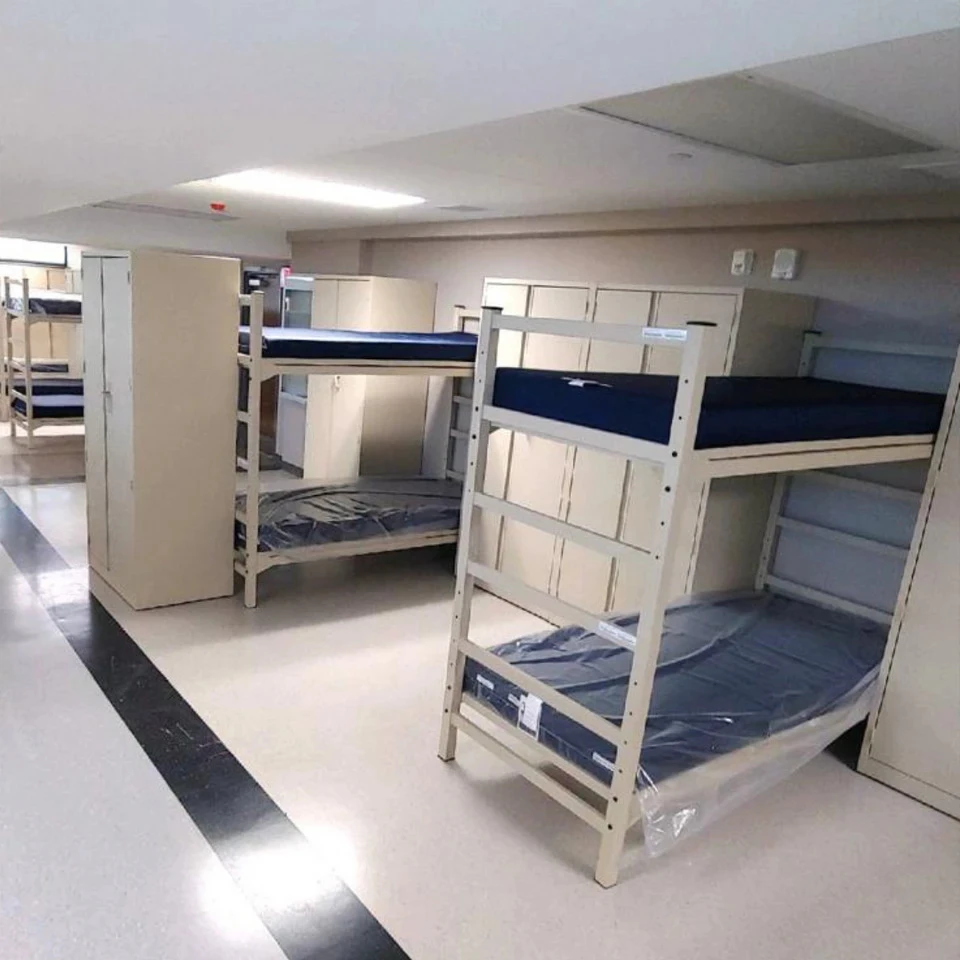
If you're outfitting a barracks, fire station, summer camp, shelter, hunting lodge, work crew quarters, or recovery facility, you're not shopping the way a parent buys a bunk bed for a kid's room. You need capacity, compliance, and longevity, usually at 8, 25, or 100+ units at a time. This guide walks you through what business buyers should know before placing a bulk bunk bed order.
Army Navy Outdoors has supplied military, government, and commercial customers for over 50 years. Below are the questions our B2B customers ask most.
The first questions our sales team will ask you
Before we recommend a bunk bed, we ask a few things, because the right bed depends entirely on the application.
What's the use case? A summer camp, a firehouse bunk room, a recovery shelter, and a county penitentiary all need very different beds. Penitentiary and high-risk-population applications, for example, typically require beds with no springs and no removable parts. Anything that could be pulled off and used as a weapon or contraband is disqualifying. A summer camp has none of those constraints and can use a standard debunkable model.
Do you already have mattresses? If you do, the mattress dimensions and thickness will dictate which bed frame is compatible. If you don't, we'll quote bed and mattress together.
How many beds, and how soon? Quantity affects pricing tier, and timeline affects whether we ship from in-stock inventory or place a custom order.
Will the beds be stacked or used as singles? This determines whether you need ladders and side rails (more on that below).
Telling our sales team the application up front saves rounds of back and forth and gets you a more accurate quote.
What weight capacity do commercial bunk beds need?
For institutional use, look for a minimum of 400 lbs per sleep surface. Heavy-duty commercial models go up to 500 lbs per platform, with total bed capacities of 800 lbs or more. Residential bunk beds typically rate 200 to 250 lbs, which isn't enough for adult, high-turnover use.
What standards and certifications matter for institutional bunk beds?
- GSA performance standards are required for sales to the U.S. military and most federal facilities
- ASTM F1427, the consumer bunk bed safety standard (note: F1427 explicitly excludes institutional use, but many commercial beds meet or exceed it anyway)
- 16 CFR 1213 and 1513, federal entrapment hazard standards
- 16 CFR 1633, the fire flammability standard for mattresses, is required for most commercial and institutional facilities
If you're buying for a state-licensed facility, ask your local fire marshal which standards apply before you order. Requirements vary by state and occupancy type.
What construction features should I look for?
- Square tube posts, typically 1¼" to 2" square in 16 to 18 gauge steel
- Powder-coated or epoxy finish that resists rust, scratches, and cleaning chemicals
- Sealed tubular construction, which eliminates harborage points for bed bugs
- Sinuous wire deck or steel mesh in place of sagging spring decks
- Tamper-resistant hardware is important for shelters, recovery, and corrections settings
Welded, not bolted: why it matters
The most important construction feature on a commercial bunk bed is fully welded joints, not bolted. As we've covered in our other bunk bed blogs, this is what determines whether the bed needs ongoing maintenance.
Bolted bunk beds loosen over time. Every time someone climbs in, climbs out, sits down, or rolls over, the joints flex. Bolts back out. Wobble develops. Maintenance staff have to tighten hardware on a regular schedule, and even then, the bed eventually fails at the joints.
Welded bunk beds have nothing to loosen. Once they're assembled, they stay that way. No tightening schedule, no joint failure. For a facility with 50 or 200 beds, the maintenance hours saved over the life of the beds add up to far more than the small difference in upfront cost. That's why welded construction is standard on every commercial bunk bed Army Navy Outdoors sells.
Bunkable vs. fixed bunk beds, and what's NOT included
This is the most misunderstood part of buying commercial bunk beds, and it catches a lot of first-time business buyers off guard.
Most commercial bunk beds are debunkable. Unless you specifically buy a solid (welded one-piece) metal bunk bed, the bed ships as two separate single beds that stack to form a bunk. That's intentional, because it lets the same product serve facilities that need singles, bunks, or both.
Debunkable beds aren't normally sold with ladders or side rails. When used as singles, they don't need either. If you're going to stack them as a bunk, you have to add:
- A ladder (one per stack)
- Side rails (commercial applications require them, no exceptions)
Always confirm with your sales rep that ladders and rails are included in your quote if you're stacking. It's a small line item that's easy to miss, and you can't skip it.
Fixed (solid) bunk beds are permanently joined and ship with rails and ladders integrated. They're more rigid per unit and work best for permanent installations like barracks and firehouse bunk rooms, where the configuration won't change.
Stackable two-high is the standard commercial configuration. Three-high stacks are available as a special order where ceiling height allows, which is useful for maximum-density shelters and disaster relief.
Special and custom orders
For larger orders of around 50 beds or more, we can custom-build to your specifications. Common customizations include:
- Non-standard mattress sizes (custom widths or lengths to fit existing mattresses or unusual room dimensions)
- Custom bed heights off the ground (for clearance, under-bed storage, or accessibility requirements)
- Three-high stack configurations
- Specific finish colors beyond the standard black or military gray
- Modified components for specialized applications
If your facility has unusual requirements that off-the-shelf models don't fit, ask. With enough volume and lead time, we can usually build exactly what you need rather than forcing you to compromise on a stock product.
Production capacity
Our factory can manufacture and ship roughly 100 bunk beds per day. That means even large orders of 200, 500, or more beds can be fulfilled on practical timelines, not the 3-month waits typical of the industry. When you request a quote, we'll give you a specific lead time based on your quantity and our current production schedule.
What about mattresses?
Most commercial customers add fire-resistant (FR) foam mattresses to their bunk bed order. For institutional use, look for:
- 4" to 6" high-density foam
- 16 CFR 1633 fire-rated cover
- Waterproof or wipe-clean vinyl or satin cover (critical for shelters, recovery, and high-turnover environments)
- Bed-bug-resistant sealed seams
Bulk pricing and lead times
Bulk bunk bed orders ship via LTL freight on pallets. Our standard packing at Army Navy Outdoors is roughly 4 bunks per pallet, so an 8-bed order is typically 2 pallets.
Volume pricing breaks typically kick in at 8 beds (2 pallets) and again at 25+ beds, with deeper discounts above that. For very large orders of 100+, contact us directly.
Lead times vary by quantity and customization. In-stock orders can ship within days. Large custom orders may run 2 to 6 weeks.
Tax-exempt buyers (charities, government, resellers) should provide certificates at the quote stage, not after the order is placed.
Payment terms for qualified business and government accounts can include POs, wire transfer, and net terms.
For any quantity of 8 or more, request a quote rather than ordering through the standard cart. Bulk pricing is meaningfully better than the listed unit price.
Freight and delivery: what we need to know upfront
Freight is the part of a bulk bunk bed order most likely to surprise a first-time business buyer. LTL carriers charge accessorial fees for anything beyond a simple dock-to-dock delivery, and those fees can add hundreds of dollars per shipment if they aren't built into the original quote.
We always prefer to quote freight at the same time we quote the beds, so there are no surprises. To do that accurately, we need to know your delivery situation. Tell us:
Do you have a loading dock? Dock-to-dock delivery is the cheapest and fastest option.
Do you have a forklift? If you don't have a dock but have a forklift, we can still ship without a liftgate, which saves money.
Do you need a liftgate? If there's no dock and no forklift, the truck needs a liftgate to lower pallets to ground level. This is an extra fee.
Is the delivery address considered limited access? Carriers flag locations with small parking lots, no commercial loading area, gravel or unpaved approaches, residential streets, schools, churches, military bases, prisons, construction sites, and remote rural addresses. Limited-access fees are standard if these aren't disclosed upfront.
Do you require an appointment or have limited hours? If your facility isn't open during normal carrier delivery windows (say, you need a call ahead, or only accept deliveries certain days), there's an appointment delivery fee. As long as we know in advance, it's straightforward to arrange.
Does the truck need to be a specific size? Some sites can't accommodate a standard 53-foot trailer and need a smaller "city truck." Tell us if access is tight.
Inside delivery? Standard freight delivery is curbside or dock only. If you need pallets brought inside the building, that's a separate accessorial.
The bottom line: disclose access restrictions before the truck arrives, not after. A liftgate or appointment fee added to the original quote is normal and predictable. The same fee tacked on as a re-delivery surcharge after a failed delivery is much more expensive.
Quick reference: common questions from business buyers
What's the weight capacity of a commercial bunk bed? 400 to 500 lbs per sleep surface is standard for institutional use.
Are your bunk beds GSA-approved? Yes. Several models meet GSA performance standards for military procurement.
Do commercial bunk beds come with ladders and side rails? Usually not. Most commercial bunks are debunkable and ship as two single beds. If you're stacking them, ladders and side rails have to be added to the order. Side rails are required for any commercial stacked-bunk application.
Can you ship bunk beds on pallets? Yes. All bulk orders ship LTL freight, typically around 4 bunks per pallet.
What freight info do you need to quote shipping? We need your delivery ZIP, whether you have a loading dock or forklift, whether the site has limited access (small parking lot, gravel approach, residential street, etc.), and whether the carrier needs to call ahead for an appointment. We always quote freight at the same time as the beds so there are no surprises.
What's a liftgate and do I need one? A liftgate is a hydraulic platform on the back of the truck that lowers pallets to ground level. You need one if you don't have a loading dock or a forklift. It's an extra fee but routine.
Do you offer fire-resistant mattresses? Yes. All institutional mattresses meet 16 CFR 1633 flammability standards.
Can bunk beds be separated into single beds? Debunkable models can. Fixed (welded one-piece) models cannot.
Do you sell bunk beds for jails and penitentiaries? Yes. Corrections applications require beds with no springs and no removable parts. Tell our sales team the application up front so we can recommend the right model.
Do you sell to government and tax-exempt organizations? Yes. Provide your tax-exempt certificate when requesting a quote.
What's the minimum order for bulk pricing? Volume pricing starts at 8 beds (2 pallets), with deeper breaks at 25+ and 100+ units.
How long do commercial bunk beds last? A properly specified, welded steel commercial bunk bed should last 15 to 20+ years in heavy-use environments.
Can you custom-build bunk beds? Yes. For orders of 50 beds or more, we can custom-make non-standard sizes, custom heights off the ground, three-high stacks, and other modifications. Ask your sales rep about the specs you need.
How many bunk beds can your factory produce per day? Around 100 per day. Large orders of 200, 500, or more can be fulfilled on practical timelines rather than the multi-month waits typical elsewhere in the industry.
Are your bunk beds welded or bolted? Welded. All commercial bunk beds Army Navy Outdoors sells are fully welded at the joints, which means no bolts to loosen, no scheduled tightening, and no wobble. Once set up, they stay that way for the life of the bed.
MILITARY GEAR GUIDES
Army Navy Outdoors: A Genuine Military Surplus Online Store
Army Navy Outdoors is a military surplus store. Not a tactical brand. We buy genuine U.S. Governmen...
How to Ship to a Military Base Address and not get it returned
This guide comes from our experience and frustration fixing countless addresses, so it gets to the p...
Can You Use Surplus FR Clothing for Fire Resistant Work?
Most people asking about surplus FR want to know one thing: can I wear this instead of paying three...

ACU Camo (UCP): Why the Army's Most Hated Pattern Is the Best Value in the Surplus Bin
This is the ugliest camo the Army has ever fielded. It's also one of the best values on our shelf. H...
Surplus Ammo Cans: What the Rust Means and How to Check One Before You Buy
Every surplus store sells ammo cans, and every prepper and shooter buys them. So most of what's writ...

What does mil-spec mean?
Real mil-spec cites a document number. "Military grade" cites nothing. That's the whole test, and it...